
Structural insulated panels (SIPs) are a building envelope system made of a rigid foam insulation core sandwiched between two structural facings, typically oriented strand board (OSB). SIPs are manufactured as complete wall, roof, and floor panels in a factory setting, then shipped to the jobsite and assembled on site. Because the insulation, structure, and air barrier are built into a single panel, SIPs reduce the number of separate layers and field-assembled joints that a building envelope depends on to control moisture.
Moisture is present on every jobsite in BC and Alberta. The question is whether the building envelope is designed to handle it.
Rain, humidity, vapor drive, condensation, and air movement show up on every build in Western Canada — from Metro Vancouver to Calgary to the Northwest Territories. The climate changes how moisture behaves. It does not change whether moisture needs to be controlled.
This article covers where moisture comes from in BC and Alberta’s different climates, where it enters buildings, how Structural Insulated Panel (SIP) building envelopes manage it more reliably than conventional framing, and what that means for BC Energy Step Code compliance.
Moisture Pressure in Western Canada: It Is Not Just a Coastal Problem
Moisture affects every building in Western Canada. The climate determines the source of the risk. The building envelope determines whether it becomes a problem.
The coastal regions of British Columbia are among the wettest climates in North America, creating unique challenges for moisture management, durability, and building envelope performance. Mild winters keep much of that moisture in liquid form throughout the year. Buildings face frequent rain, high humidity, and prolonged wetting periods that place continuous demands on the building envelope. Water intrusion and condensation within wall assemblies can both be active risks at the same time.
Alberta and BC’s interior face a different but equally serious challenge. Cold winters create large temperature differentials across wall assemblies, often 40°C or more between interior and exterior conditions. That differential increases the potential for moisture-laden indoor air to migrate into wall assemblies, creating a risk of condensation at or near the sheathing layer. Interior moisture from cooking, bathing, and normal occupancy can accumulate inside wall cavities if it is not properly managed.
BC’s transition zones, including the Okanagan, Thompson-Nicola, and mountain communities, often experience both moisture pressures within the same year. An envelope that manages exterior moisture but not interior vapor, or vice versa, may develop moisture-related issues that remain hidden for years before becoming visible.
In every climate zone, uncontrolled air leakage is often a greater source of moisture transport than vapor diffusion alone. Regardless of climate, moisture most often enters buildings through air movement at joints, seams, and transitions, not through materials themselves. The design challenge is maintaining envelope continuity across every one of those locations.
Where Moisture Enters Buildings — and Why Envelope Design Is the Variable
Moisture enters buildings at gaps in the envelope — not from material failure alone, but from how components come together at joints, transitions, and changes in assembly.
Air carries moisture. When air moves through gaps in the building envelope, it transports moisture into wall and roof assemblies where it cannot dry out. This happens even when individual materials are high quality. Performance depends on how well the envelope functions as a continuous system across every layer, not on the spec sheet of any one product.
In coastal BC, the highest-risk locations are the exterior face: cladding-to-sheathing interfaces, window and door rough openings, and wall penetrations. In Alberta’s cold interior, the highest-risk locations are the interior side: vapor retarder continuity, electrical and plumbing penetrations, and any point where warm interior air can reach a cold surface.
The most common entry points across all climates:
- Panel joints and seams
- Window and door openings
- Roof-to-wall transitions
- Changes in material or assembly
- Mechanical and electrical penetrations
When continuity breaks down at any of these locations, moisture finds a path inside. The more locations that must be coordinated and sealed independently in the field, the higher the probability that one of them fails.
SIPs vs. Conventional Framing for Moisture Control in BC and Alberta
SIP building envelopes can simplify moisture management by reducing the number of layers, joints, and field-assembled transitions that must be detailed correctly to maintain envelope continuity.
| Factor | SIP Envelope | Conventional Framing |
| Air barrier continuity | Factory-manufactured panels with sealed joints and SIP tape systems. Fewer gaps by design. | Assembled in the field from multiple layers. Continuity depends on sequencing, detailing, and coordination between trades. |
| Moisture entry points | Reduced. Fewer joints, seams, and transitions require sealing. | Higher. Continuity must be maintained across more layers, interfaces, and penetrations. |
| Performance in coastal BC rainfall | Continuous insulation and sealed panel joints help reduce potential pathways for air and moisture movement. | WRB continuity, flashing details, and field installation quality play a significant role in long-term performance. |
| Cold-climate vapor risk | Continuous insulation helps keep sheathing temperatures warmer and reduces the potential for condensation within wall assemblies. | Thermal bridging through framing members can create colder surfaces where condensation is more likely to occur. |
| BC Energy Step Code airtightness | SIP assemblies routinely achieve low ACH50 results, helping projects meet aggressive airtightness targets with fewer supplemental airbarrier measures. | Achieving higher levels of airtightness often requires additional air barrier products, detailing, and field coordination. |
Note on the table: ACH50 targets should be confirmed against the current BC Building Code cycle. The Intertek performance report — which West-Eco uses as the primary technical reference for the BC market — provides envelope performance data applicable to BC code requirements. Builders evaluating SIPs for an upcoming project can learn more about the full benefits SIPs provide here.
How SIP Sealing Maintains Moisture Control at the Highest-Risk Points
Sealants and SIP tape at panel joints are what make the SIP envelope a continuous system rather than a collection of panels. In coastal BC and cold-climate Alberta, this detailing is not optional — it is where the performance is.
Sealants at Joints and Transitions
Sealant is applied at every joint and transition point — where panels meet each other, where they meet the foundation, at roof connections, and at window and door openings. Correct sealant application maintains continuous air and moisture control at the most vulnerable locations in the assembly.
Sealants at these locations:
- Limit air movement that carries moisture into the assembly
- Protect transitions that are statistically the highest-risk points for moisture entry
- Maintain long-term durability of the envelope at the connections between panels
In Metro Vancouver, the Fraser Valley, and coastal BC, sealant at panel joints is a primary moisture defense — not a secondary precaution. The volume and persistence of exterior moisture pressure in these climates means any unsealed gap will eventually be found.
SIP Tape at Panel Seams
SIP tape reinforces the air and moisture control layers at panel seams. Used alongside sealants, it keeps the control layers connected across panel joints –the locations where continuity is hardest to maintain in field-assembled alternatives.
SIP tape:
- Strengthens the air barrier at seams
- Helps manage vapor movement through the assembly
- Reduces the risk of moisture intrusion at the most common entry points
This seam continuity is also directly relevant to BC Energy Step Code airtightness testing. SIP assemblies consistently achieve low results on the blower door test, measured in ACH50 (air changes per hour at 50 Pascals of pressure) — the lower the number, the tighter the building. SIPs hit the low ACH50 numbers that Step 3, 4, and 5 require not because of additional air barrier products, but because the sealing is built into how the panels are installed.
Airtight Envelopes Need Intentional Ventilation — Here Is Why That Matters
An airtight SIP envelope controls where air moves. That means moisture from occupants — cooking, bathing, breathing — must exit through a mechanical ventilation system, not through gaps in the envelope. This is not a limitation; it is how moisture gets managed deliberately instead of accidentally.
Relying on air leakage to carry moisture out of a building is unpredictable. Leaks change with wind pressure, temperature, and building age. A ventilation system can be designed, commissioned, and operated to specific performance targets.
In BC and Alberta climates, heat recovery ventilation (HRV) is the standard pairing with an airtight SIP envelope. An HRV is a mechanical ventilation unit that continuously exhausts stale, moist interior air and replaces it with fresh outdoor air, while transferring most of the heat from the outgoing air into the incoming air. The building stays dry, comfortable, and energy-efficient at the same time.
The BC Energy Step Code connects these two requirements directly. Steps 3 and above require verified airtightness blower door testing. Step 5 (Net Zero Ready) requires envelope performance that conventional framing routinely struggles to hit. A SIP envelope makes those targets more predictable because the airtightness is designed in, not added layer by layer after the fact.
Coastal BC: Why Moisture Control Is a Durability Requirement, Not a Preference
For builders working in Metro Vancouver, the Fraser Valley, Vancouver Island, and the BC Coast, moisture control is not an upgrade. It is the baseline for a building that will perform over its design life.
The combination of high annual rainfall, mild winters, and decades of wood-frame construction in this climate has produced well-documented results. Mold, rot, and envelope failures have cost BC homeowners and developers billions in remediation costs over the past thirty years. The lesson from that history is not that wood-frame construction cannot work in coastal BC — it is that it requires a level of envelope continuity and detailing discipline that is difficult to achieve consistently with field-assembled, layered systems.
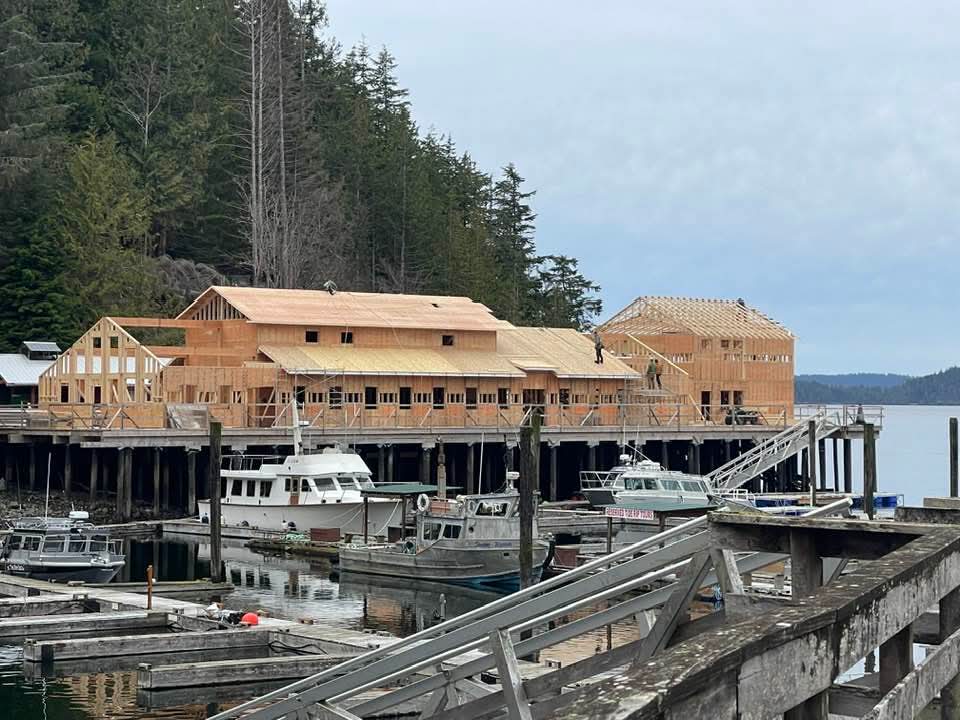
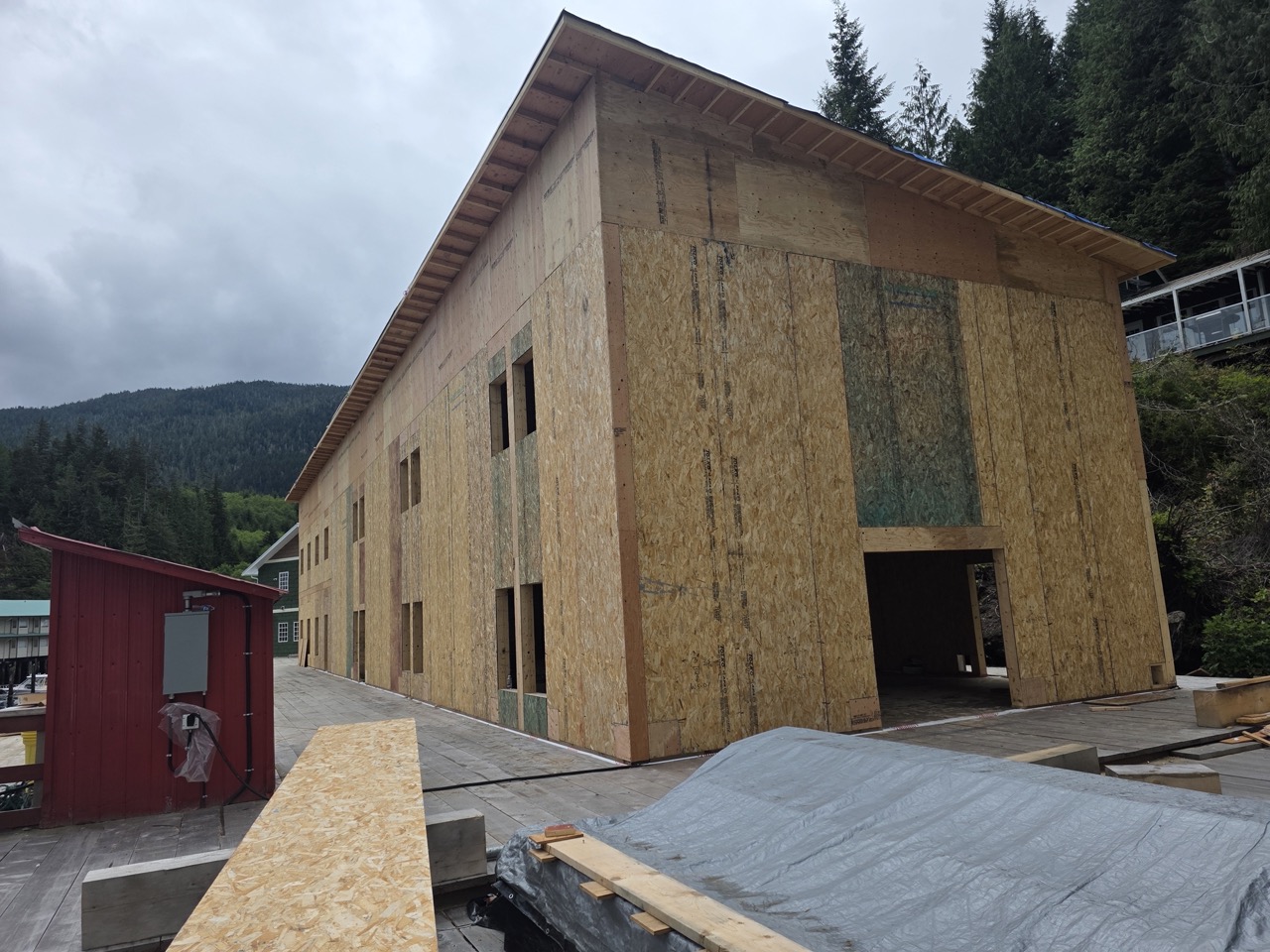
West-Eco has supplied SIP envelopes for projects across coastal BC and high-rainfall mountain environments — including the Telegraph Cove Resort rebuild on northern Vancouver Island, one of the most exposure-intensive sites in BC. A SIP envelope in a build like Telegraph Cove is not chosen for cost reasons. It is chosen because the performance needs to hold in conditions that test conventional assemblies hard.
For coastal builds, West-Eco SIP panels can be supplied with zinc borate-treated OSB. The treatment is applied during manufacturing, which means the protection is built into the panel itself — not field-applied, not dependent on a coating that can be missed or damaged during installation. Zinc borate resists fungal decay and termite damage from the day panels arrive on site through the life of the building. In a climate where mold and rot are the documented failure modes for conventional assemblies, starting with panels that resist those failure modes at the material level is a meaningful difference from untreated alternatives. For full technical specifications, including warranty details, see the West-Eco zinc borate OSB product data sheet.
SIPs address the coastal moisture problem at the design level — fewer joints to seal, fewer interfaces to coordinate, fewer opportunities for continuity to break down. The zinc borate treatment adds material-level protection that works alongside the envelope system. Together, they address the two most common failure modes in coastal BC construction: moisture intrusion at the envelope, and biological degradation of structural materials once moisture finds a path in.
Moisture Does Not Wait for the Right Climate
Every building in BC and Alberta encounters moisture. The climate determines the form — rain, vapor, condensation, or all three. The envelope determines whether it stays outside.
SIP building envelopes reduce the number of locations where moisture can enter and make the performance you design for the performance you actually build. In coastal BC, that means fewer callbacks and fewer remediation conversations. In Alberta’s cold interior, it means wall assemblies that stay dry through decades of temperature cycling.
If you are building in BC or Alberta and want to talk through how a SIP envelope performs in your specific climate and project type, West-Eco’s team works with builders and designers across the region. We supply, we support installation, and we know the climates these buildings go into.
Talk to West-Eco SIPs about your next project.
Frequently Asked Questions: Moisture Control and SIP Construction in BC and Alberta
How does moisture enter buildings in BC and Alberta?
Moisture enters through air movement at joints, seams, and transitions where envelope continuity breaks down. In coastal BC, persistent exterior rainfall amplifies any gap in the assembly. In Alberta’s cold interior, vapor driven by temperature differentials is the primary risk.
Why is coastal BC considered a high-risk moisture environment for buildings?
Annual rainfall in coastal BC exceeds 1,500 mm in many areas, and mild winters keep moisture in liquid form year-round. Buildings face continuous exterior moisture pressure without the freeze cycles that reduce risk in colder climates. Envelope continuity is non-negotiable in these conditions.
How do SIPs manage moisture better than conventional framing?
SIP building envelopes have fewer joints, layers, and field-assembled interfaces to seal. This reduces the number of locations where moisture can enter and makes it easier to maintain continuous air and moisture control across the entire assembly. Fewer transitions means fewer opportunities for continuity to fail.
Do SIPs eliminate moisture risk entirely?
No building system eliminates moisture risk. SIPs reduce it by improving envelope predictability and reducing entry points. Correct installation, sealing, and ventilation detailing are still required. What SIPs provide is a system that makes correct
performance easier to achieve consistently.
Do SIP buildings need mechanical ventilation?
Yes. An airtight SIP envelope must be paired with intentional mechanical ventilation — typically a heat recovery ventilator (HRV) in BC and Alberta climates. The HRV manages interior moisture from occupants and activities deliberately, rather than relying on air leakage. This is how moisture is controlled in a tight building.
How do SIPs help with BC Energy Step Code airtightness requirements?
BC Energy Step Code Steps 3 and above require verified airtightness testing (blower door test). SIP assemblies consistently achieve low ACH50 results because the sealing is part of the installation process — not added afterward. This makes Step 3, 4, and 5 targets more predictable and achievable than with conventional framing and added air barrier layers.
When in a project should moisture management be decided?
At the envelope selection stage, before components are specified. Moisture management is most effective when it is designed into the assembly from the start. Retrofitting moisture control strategies after the envelope system is defined adds cost and complexity and reduces reliability.
Is the Intertek report relevant to BC building code compliance for SIPs?
Yes. In BC, Alberta, and the Northwest Territories, the Intertek performance report is the primary technical reference for SIP compliance — not the ICC report, which is not recognized by BC or Alberta authorities having jurisdiction. West-Eco references the Intertek report for all technical performance claims in the Canadian market.